 ArbScreener
live
Launch ↗
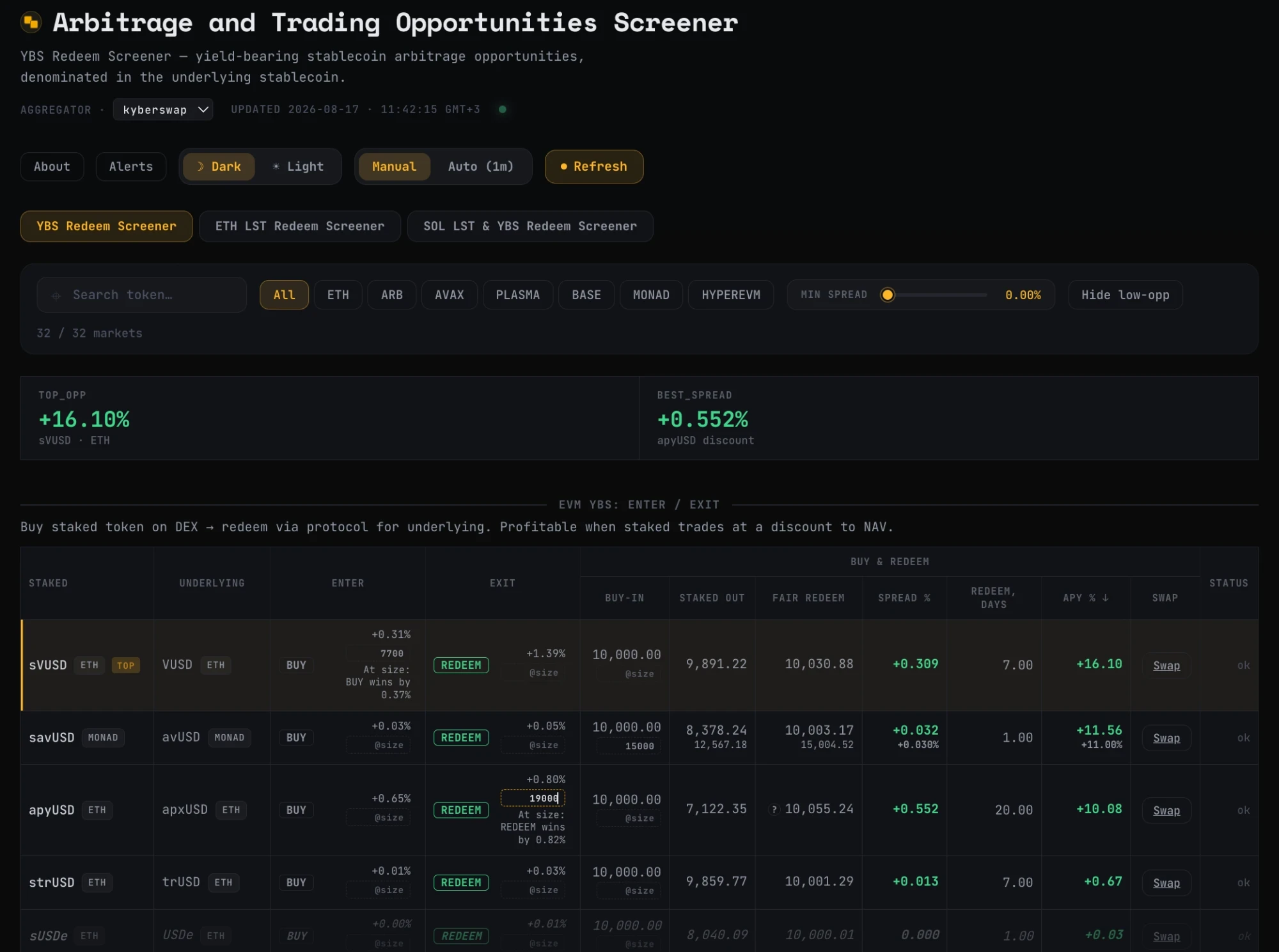
ArbScreenerEvery yield-bearing token has two prices: what it trades at on the market, and what it redeems for on-chain. Arbitrage Screener reads both and tells you, per token, the cheaper way to enter (buy on a DEX vs. mint) and the cheaper way to exit (sell on a DEX vs. redeem) — right now. When the market lags the redemption value, it also surfaces the arbitrage and annualizes it as an APY. Every figure in the underlying asset, never USD — no dollar oracle, no soft-peg noise.
For every yield-bearing stablecoin and LST, the board answers three questions in one row — in order of how often you'll use them.
Buy the token on a DEX, or mint it via the protocol? We pull a real buy quote at a standard notional (slippage priced in) and compare it to the on-chain mint rate. Verdict: BUY or MINT. A DEX buy usually wins — the value is catching the rare moment it doesn't.
Sell on a DEX, or redeem via the protocol? We compare a real sell quote to the protocol's redemption value (net of fee, over its redeem window). Verdict: SELL or REDEEM. This one flips often — SELL means the market is paying above redemption value, so selling beats waiting on a redeem.
When a token trades below the value it redeems for, that discount is a capturable spread. We annualize it over each protocol's real redemption window — instant, a cooldown, or a queue — so opportunities compare as a single APY. Negative and near-zero spreads are shown honestly too; an efficient market is an answer, not an empty screen.
Everything above is denominated in the underlying token, so a de-pegged crvUSD or DOLA never distorts the math the way a USD oracle would. Free shows every verdict's direction; Pro adds the exact magnitude, a quote at your own size, direct mint/redeem links, and Telegram alerts.
Same idea everywhere — for each token, the cheaper way in (buy on a DEX vs. mint) and the cheaper way out (sell on a DEX vs. redeem), plus the redemption spread as an APY. All priced in the underlying.
Yield-bearing stablecoins and non-KYC mintable stablecoins on EVM chains: buy vs. mint to enter, sell vs. redeem to exit, and the discount to redemption value as an APY.
Ethereum liquid-staking tokens vs. their on-chain ETH value: buy vs. mint to enter, sell vs. redeem to exit. Redeem windows range from instant to a multi-week validator queue — and the wait is priced into the APY.
Solana LSTs and stables: buy vs. mint to enter, sell vs. redeem to exit. Redemption settles at the epoch boundary (~1–2 days) and staking rewards keep accruing while you wait — so the board shows both spot and projected value.
The board tells you what's cheaper now. Alerts tell you the moment it changes — so you're not watching a screen all day. Delivered to Telegram. Pro.
Set an APY threshold. When any tracked asset's redemption spread rises above it, the bot messages you once — and re-arms only after it drops back below and crosses again. No spam.
Get pinged when a token's better exit flips REDEEM ↔ SELL — the moment the market starts paying above redemption value, or stops. The signal that the trade just turned.
See the spreads for free. Go Pro to act on them — size-aware quotes and Telegram alerts.
Free
See the spreads. No card, no wallet.
$0
Pro
Act on the spreads, at your size.
$39.90 / yearPay on-chain in USDC / USDT · one flat price
Read-only — ArbScreener never signs, routes, or custodies funds. Pro is a flat $39.90/year, paid on-chain. Cancel anytime — it simply won't renew.
Already have a code? Enter with a code ↗ · Terms of Service